Showing posts with label Vertigo. Show all posts

Friday, August 10, 2012

In Search of the Psychological Gothic


Earlier this year when I started self-publishing my writing in eBook form, another writer encouraged me to come up with a moniker or other identity for myself and my writing. I landed on the term Psychological Gothic which seemed to fit what I try to accomplish in my stories. My four published and one forthcoming work are all stepped in Gothic atmosphere, all with an Old Dark House as a central character in the stories. In terms of structure and characters my stories are psychological thrillers.

I doubt that I'm the first person who put this combination of words together, so I have scoured the internet in hopes of finding some reference to the term. The only thing I have been able to find is a write-up on a low budget independent thriller from 2008 in which the reviewer stated the movie combined the psychological thriller with Gothic horror. That can apply to any number of books and movies. Why not come right out and use two words instead of four?

The obvious Psychological Gothics would be Turn of the Screw and a trio of Shirley Jackson novels, The Sundial, We Have Always Live in the Castle, and The Haunting of Hill House. Turn of the Screw and The Haunting at Hill House share a few things in common. They are each ghost / haunted house stories that have captivated the public’s imagination for years. They also have a deeply disturbed heroine and, film versions aside, the novels leave the story open for interpretation. Are Eleanor Vance and The Governess actually experiencing paranormal manifestations, or are they simply mad? This is no easy feat to pull off, which is another reason why these literary works have endured as long as they have.

Not being overtly horror novels, The Sundial and We Have Always Lived in the Castle are not as widely read and revered as The Haunting of Hill House, I would still suggest that all three are Psychological Gothics. The Sundial features a family of crazies holed up in a brooding old house waiting for the end of the world, while We Have Always Lived in the Castle is a mesmerizing portrait of a criminal mind told from that mind’s (as unreliable narrator) point of view. In all three of these books the reader encounters Jackson’s themes of agoraphobia, a psychological ailment which the author herself suffered.

I propose that a number of novels from the second half of the twentieth century which were labeled horror at the time of publication are really Psychological Gothics. Today we tend to refer to them as “quiet horror.” Thomas Tryon’s classic, The Other, and even Rosemary’s Baby with the Bramford standing in for the Old Dark House and Rosemary’s increasing sense of paranoia, are solid examples of Psychological Gothics. Even the classic romantic suspense novel, Rebecca, places more emphasis on the psychology of its characters than did the hundreds of Gothic Romance imitators which followed in its wake. One needs only to read any number of Daphne Du Maurier’s other novels to come to the conclusion that she was writing psychological thrillers.


Psychological Gothic is more proliferate in the movies: Session 9, Dark Water, The Others, even Whatever Happened to Baby Jane? and the Hitchcock films Psycho and Vertigo fit neatly into this category.

Today, there are a few writers of crime/psychological thrillers who are edging into Gothic territory. The Irish writer, John Connolly, whose private eye, Charlie Parker, is haunted by ghosts and other supernatural manifestations in such relentlessly dark novels as Every Dead Thing, The Unquiet, and The Killing Kind is often compared to Stephen King, if for no other reasons than that parts of his series are set in the backwoods of Maine, and there are bona fide supernatural occurrences in the stories. Connolly writes in a typical American noir/hard boiled style and his ghosts are never exploitive, something which makes the events in his novels that much more chilling.


A few years before the movie came out I stumbled on Dennis Lehane’s Shutter Island. Browsing the reviews on GoodReads, a number of readers panned it for its melodrama, “trick ending”, and “horror movie trappings.” What was clear to me and what many readers either can’t accept or just don’t want to stomach, was that this book is a richly layered Gothic thriller. That is what Lehane set out to write and he pulled it off brilliantly. Teddy Daniels steps into the Old Dark House (Ashcliffe asylum) in the midst of an over-the-top Gothic storm (the hurricane) in search of a monster (an escaped lunatic)… ultimately confronting his own demons. If this is not a Psychological Gothic, I don’t know what is.

Because I really enjoy this sort of thing, I’m still searching. The titles I’ve mentioned here are the obvious choices, but I know there are others. I’ll find them. If you have titles to add to the genre, drop me a line. We’ll make a list on Amazon or GoodReads. I’m always looking for unique titles in both fiction and film to review and promote here. And if you are surfing the interwebs and find reason to throw the term at someone, be my guest. I haven’t trademarked it yet.


Saturday, June 30, 2012

Mini Hitchcocks: Scream of Fear


Any serious fan of Hammer Films knows all about these juicy little gems, but for the more casual viewer who thinks of Hammer’s output as the Christopher Lee Dracula and Peter Cushing Frankenstein series, you’re in for quite a treat.

The film company itself coined the term “mini-Hitchcock” which had a two-fold meaning. These stories were modeled after the suspense films Psycho (and to a lesser degree, Vertigo), and were produced on an even lower budget than Psycho.

I’ve often compared these Women in Peril stories to some of the Gothic Romances of the same era. Scream of Fear (Taste of Fear in Britain) came out in 1961. Its mechanical plot twists borrow heavily from the aforementioned Hitchcock titles, but also from women’s suspense thrillers of the day. Mary Stewart’s The Ivy Tree comes to mind.

Scream of Fear is the first and arguably the best of the series (which also includes Maniac, Paranoiac, and Nightmare, among others). Jimmy Sangster’s script is chock full of red herrings and surprise twists, some of them less plausible than others. Props go to director Seth Holt for making it all look classy and believable.

Susan Strasberg plays Penny Appleby, a wheelchair bound, dark haired waif in oversized Foster Grant sunglasses, who returns to the home on the French Riviera she has not visited in more than ten years. Here she meets her new stepmother, Jane (Ann Todd), Robert, the handsome chauffeur, and Dr. Pierre Gerrard (Christopher Lee), her father’s physician. Papa Appleby, however, seems to be missing. Or is he? Penny talks to him over the phone – the day after seeing his corpse propped up in a chair inside the pool house. Is Papa dead? Is Penny mad, or is something more sinister going on?

I’m a big fan of psychological thrillers and mysteries with clever twists and turns. This sort of movie makes me giddy and I can pop one of them in the DVD player several times a year. Others may throw up their hands in despair crying, “Give me a break!” Whichever the case, if you are unfamiliar with these twisted little thrillers and have a pining for lovely old black and white suspense films, track this one down. And as always, thank me later.

Tuesday, February 14, 2012

Vertigo - Hitchcock's Gothic Valentine

“Do you believe that someone out of the past, someone dead, can enter and take possession of a living being?” Gavin Elster asks retired detective Scottie Ferguson at the beginning of the 1958 masterpiece, Vertigo, Hitchcock’s strange tale of obsessive love.

But is it Gothic? Of course it is, as much as that other classic of obsessive love, Wuthering Heights. Gothic doesn’t always require the histrionics of thunderstorms and old dark houses, though the Gothic eye candy is always appreciated. 
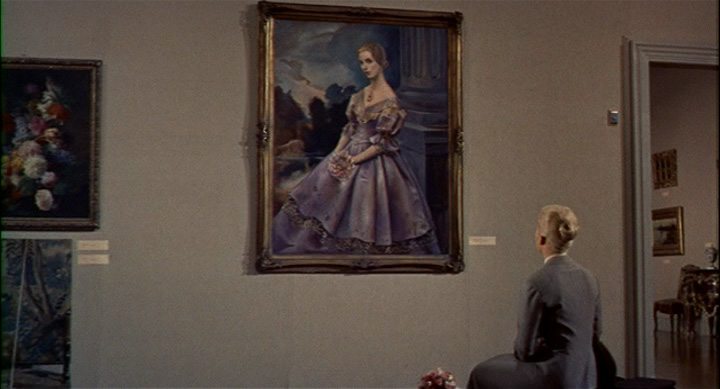
Vertigo has its fair share of Gothic tropes: the woman apparently possessed by an ancestor who committed suicide after a long battle with mental illness; the old dark house, the McKittrick Hotel, once home to the mad Carlotta Valdes; the mysterious portrait (Carlotta again), and a nifty bit of repressed Freudian symbolism with the metaphorically mpotent Scottie unable to save the beguiling Madelyn Elster when she makes her ascent into that juicy phallic symbol, the bell tower at San Juan Bautista.
Besides, Bernard Herrmann’s score is one of his best. I can’t imagine the film without it, and find myself listening to it repeatedly during writing sessions for my own Gothic fiction. It’s lushly romantic and appropriately punctuated by moments of mystery and sheer suspense.
It’s no wonder that Hammer Studios, inspired by the third act plot gymnastics of Vertigo and Hitch’s other masterpiece, Psycho, tried their hand at Gothic tinged psychological thrillers such as Scream of Fear, Paranoiac, and Nightmare with varying degrees of success.

If you’ve never seen Vertigo, or haven’t watched it lately, February 14th is a great day to revisit this mesmerizing ode to obsessive love. Is there any other kind?