Showing posts with label Cover Art. Show all posts

Saturday, August 25, 2012

Classic Gothic Romance Cover Artists: George Ziel


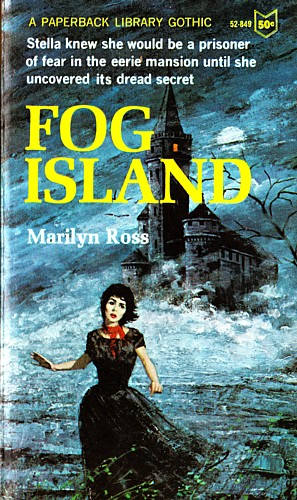
It’s been awhile since The Midnight Room took a trip to the used paperback bookstore. This week I’d like to introduce readers to the terrifying Gothic imagery of George Ziel (1914-1982). Whereas artists like Harry Bennett and Lou Marchetti emphasized the romantic elements in their Gothic Romance paintings, George Ziel emphasized the Gothic. His heroines wear expressions of palpable fear, eyes often wide with terror. If that isn’t enough, he frequently incorporates other Gothic and occult elements including black cats, skulls, candles, and swarms of black bats that skitter across the painting.

Original painting for Paperback Library for the cover of Shorecliff by Marilyn Ross

Ziel’s images of death and fear are so striking that he employed virtually the same style for his series of thirty-one cover paintings for Jove’s paperback reprints of New Zealand mystery novelist Ngaio Marsh, as well as covers for the George Simenon reprints for Pocket Books.


Gothic Romance collectors, however, are more familiar with his work for Paperback Library where he produced outstanding covers for titles by such prolific writers as Christine Randell, Dorothy Daniels, and Marilyn Ross, often delivering three to four paintings a month. In an era when writers could not produce original Gothic Romance novels fast enough, publishers such as Paperback Library often reprinted older mysteries and some classic works, sometimes with new titles, always with an eye toward attracting the readers who sought these books ravenously, month after month, for nearly two decades.


Archivist Lynn Munroe presents an extensive portrait of Ziel’s life and work at Lynn Munroe Books wherein he states: “Ziel appeared to have tapped into our darkest fears and nightmares, and presented them on vivid paperback covers. Some of them were romances, some were mysteries; all of them were haunting. The average reader, with no knowledge of Ziel’s past, could only wonder. To those who knew his story, the signposts were all clearly marked. Like all great artists, George Ziel drew on his own experiences and memories, his own visions and nightmares, to infuse the horrifying world of his best cover art. Although he rarely signed his name or received a printed artist credit, he nonetheless became a true modern master of horror.”
 

The story of Ziel’s past is as horrifying as any of his covers. He was born Jerzy Zielezinsky in Poland in 1914 where, as a youth he was relegated to the Warsaw Ghetto before ultimately being shipped off to Dachau.

As “an artist; he felt a powerful need to create art that the restrictions at Dachau could not destroy. Paper and pencils were forbidden, so Jerzy used to sketch on pieces of scrap paper using bits of charcoal. He made sketches of his fellow prisoners and of life in the camps.  When Dachau was liberated, Jerzy was taken to a hospital. During his convalescence there, he turned his rough sketches into drawings and created new images from the memories burned into his mind.”

Is it any wonder then that Ziel’s covers for Gothic Romance paperbacks are infused with more dark imagery than the majority of his contemporaries?


For more book cover goodness, visit the George Ziel checklist at Munroe’s website. I’d also like to personally thank Munroe for allowing me to use material from his exhaustive overview of Ziel’s life and work.


Saturday, March 10, 2012

Classic Gothic Romance Cover Artists: Harry Bennett

Any fan of classic Gothic Romance paperbacks from the 1960s who religiously scavenges used book stores and trolls eBay to satiate their appetite is familiar with the remarkable covers of Harry Bennett. Not only did he sign his work, making them easy to identify, but along with Pocket Books’ art director, Milton Charles, he helped create a lushly romantic and easily recognizable style that was often imitated by other artists throughout the genre’s two decade heyday.

Harry Bennett was born in New York State, raised in Connecticut, and after a tour of duty in South America during World War II studied painting and illustration at Chicago’s American Academy of Art.

Harry was a facile master at medium and technique and managed to adapt with the times and his own interest. In the 1950's he used caseins, gouache, and oils. In the 1960's he variously used colored inks, collage, oil, acrylic, and spent years working with egg tempera. He was fascinated with the old masters' techniques and mediums and made his own egg tempera paints and oil paints as well. "Black oil", or 'maroger medium', was a personal favorite oil paint medium, based on recipes from Rubens and the Baroque painters.


Harry’s commercial career began in advertising where he created illustrations for Pepsi Cola and U.S. Keds, among others, before turning to book cover illustrations. The Gothic covers began to emerge in the late 1950s with his first egg tempera and oil glaze illustrations for such early Mary Stewart novels as Madam, Will You Talk? And Thunder on the Right. Already in Thunder on the Right we can see the beginning of the “windswept” look which would become more pronounced and clearly defined as his career as one of the premier illustrators of Gothic Romance paperbacks blossomed. While Harry created covers for the major paperback publishers of the day, Simon and Schuster's Pocket Books, Avon, Dell, Berkeley, and Bantam Books, Fawcett Crest was a leading reprint publisher for established best-selling novelists with large print runs. With only a minimum of effort collectors can easily turn up Harry Bennett covers on novels by such Gothic Romance luminaries as Barbara Michaels, Mary Stewart, Phyllis Whitney, and Victoria Holt.


In his 60s, Harry Bennett retired from the industry and pursued a lifelong dream: he moved to Oregon and spent the next twenty years pursuing his personal artistic vision painting and exhibiting original work. One of Harry’s greatest achievements was a series of more than 100 paintings created with ink over gessoed board for a 1966 edition of Dante's Divine Comedy (translation by Louis Biancolli, published by Washington Square Press).

I’ve had a lifelong affinity for the cover artwork of Harry Bennett. One of the first paperback novels I bought as a ten year old was Barbara Michael’s Prince of Darkness, and I have been hooked on Harry Bennett covers ever since. I search eBay on a regular basis, buying books I will never read just to have another Harry Bennett cover for my collection. It is a pleasure to be able to share these magnificent works of art with my readers here and other fans of paperback art throughout the internet. I would also like to extend my heartfelt appreciation to Harry’s youngest son, Tom, who has graciously corresponded with me providing more biographical material and anecdotes than I knew what to do with. Thank you Tom and thank you Harry Bennett.

In 2005, Harry Bennett enjoyed a collaborative exhibit with his son, artist Tom Bennett, at the Riversea Gallery in Astoria, Oregon. This article featuresrare internet photos of the artists together.


Saturday, January 14, 2012

Classic Gothic Romance Cover Artists: Lou Marchetti

A significant contribution to the runaway success of the paperback Gothic Romance boom of the late 60s and early 70s was the seductively sinister cover illustrations. Unlike the majority of today’s romance novel cover art, paranormal and otherwise, which tends to focus on a peacock alpha male with his shaved chest pumped and oiled to entice the reader to pick him up from the bookstore shelf or download him to her eReader, the Golden Era Gothic Romances emphasized the mystery aspects of the genre’s content. The template showed a frightened heroine desperate to escape a sinister looking house or castle thrust phallus-like against a storm-tossed sky. Whenever a male figure did appear he was but a shadowy figure in the background, his features intentionally obscured by shadows and a billowing black cloak. If this wasn’t enough to make a Gentle Reader’s heart skip a beat as she dug fifty cents out of her purse, what was?


To heighten the sense of threat, the foreboding house often had a narrow sliver of light in a single window like a watchful eye keeping track of the desperately fleeing heroine to make certain she didn’t stray too far from the grounds of the estate. This lighted window, in fact the entire motif of the Gothic Romance cover, was the brainchild of one man, Lou Marchetti.
One of my favorite details on these covers is the fact that the desperate heroine always has time to slip on her travelling gloves before she flees the house of menace.

From the early 1950s through the late 1980s, Marchetti was a prolific cover artist in all genres for the leading paperback publishers of the era including Avon, Ballantine, Pocket Books, Dell Warner, Lancer, Popular Library and Fawcett Publishing.

Scans of Marchetti’s Gothic Romance cover illustrations are plentiful and easy to find on the internet, but unlike other Gothic Romance cover artists, Marchetti’s legacy is kept alive by his daughter Louise Marchetti Zeitlin on the website Loumarchetti.com featuring original cover art (sans titles and lettering) of both Gothic Romance as well as his equally outstanding work for pulp fiction genres such as crime, noir, and juvenile delinquent titles. More cover artwork can also be viewed on the Lou Marchetti Facebook page.

Friday, November 11, 2011

Charles Geer, American Illustrator


Charles Geer (1922 – 2008) was an American illustrator and author. Best known for his illustrations in numerous children's books, including The Mad Scientists' Club published between 1960-1968, Geer was also a prolific hard cover jacket illustrator for Dodd Mead, William Morrow, and other publishers of Mysteries and Gothics throughout the 1960s.


I have always been fond of Geer's use of watercolor techniques to convey mystery and emotion in his jacket paintings, from the cool shadows on a hot summer day as in Return to Aylforth, to the splendid sunset of Black Is the Colour of My True-Love's Heart and the light reflecting on the storm tossed waves in Lyonesse Abbey.


All scans are from my personal collection. No copyright claimed or intended.